Tuesday, February 24, 2009

Tipping the Long Black Tailed Swan

Here is an amusing graphic posted over at Paul Kredrosky's blog, which he credits to some people over at Wired as representing credibility versus time for some book-driven memes of recent note.

stat

The Black Swan is currently enjoying a spike of notoriety, as we live through the sub-prime crisis, unpredictable in both its occurrence and impact. But once we recover, perhaps slowly, the dreaded low-probability high-impact event will recede from popular memory, as predicted by its author Taleb. But for the moment he is living out his dream as a public intellectual.

I would suggest that the curves for the Long Tail and the Tipping Point be exchanged, since I think the former has persisted longer in the common perception as the thesis is somewhat more compelling. The Tipping Point is more a clever retelling or repackaging of fad phenomena, while the Long Tail captures more of the current Zeitgeist. In short, Malcolm Gladwell had to write another book before Chris Anderson did. Both memes are now in decline, the Tipping Point from natural attention attrition while the Long Tail has been dealt several heavy body blows based on observed data. But more about that in another post.

Monday, February 9, 2009

The Black Swan on Scribd

You can get a copy of Taleb's great Black Swan book on Scribd, as well as many reviews and other comments.

The Black Swan - The Impact of the Highly Improbable

I have also put my post on Some Black Swans for IT Security onto Scribd as well.

Some Black Swans in IT Security

Wednesday, February 4, 2009

Financial Cyber Risk Guide from ANSI

In October last year ANSI released a new guide addressing the financial impact of cyber risks. From the title you may expect lengthy calculation is costing cyber risks but in fact the document is largely a set of question to create a dialogue around cyber risks. This is not a consolation prize. I have written a short summary of the document which you can read from Scribd below. You can also read a quick review from the Security4all blog.

ANSI approach to the financial impact of cyber risk

Tuesday, February 3, 2009

SOX in Pictures

A few years ago now I worked on a project where we were considering to what extent it was possible to automate the parsing of laws and regulations to produce compliant instructions for IT Operations.

An initial step was to read SOX and hand-parse the text by stripping it of general verbiage, leaving only subjects acting on objects through actions. You can see some of the resulting diagrams below at Scribd.

Parsing SOX into Pictures

The Cobbler and the Shoe Assassin

Recently an Iraqi journalist threw one shoe, followed by the other, at former US President George Bush during a press conference. Bush executed a deft sidestep, a well-practiced response to unexpected issues at this late stage in his presidency.

The Turkish company that makes the projectile shoes has subsequently experienced a 4-fold increase in orders and plans to hire 100 new staff. Isn't it nice to see that the President can still create jobs?

It makes you wonder if the whole incident was orchestrated by the company's sales department to meet end-of-year targets.

via Bloomberg

Thursday, January 29, 2009

Little trust in Corporate Blogs

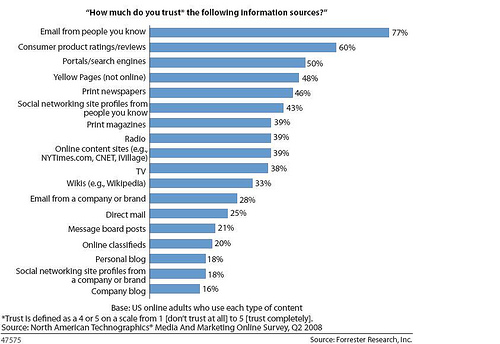
The chart below shows the results of a recent online survey from Forrester which states that only 16% of respondents trust corporate blogging information. Personal blogs are only slightly higher at 18% (do you believe me?) and newspapers remain quite reliable at 48%. However the clear winner at 77% is personal email from someone you know.

However, as expected, not everyone agrees with the results or what they seem to imply. Trust can still be earned, or lost, no matter who you are.

3094358118_0122b16c5c4

Data Centric Security Model hot on Scribd

My paper on Data Centric Security has made it to the hotlist on Scribd, which means that the paper is getting quite a few hits of late. I blogged about this work in one of my first posts to No Tricks back in September 2007. If you Google the topic further you will find that IBM has taken the idea a lot further since this initial work, and I believe that a whole consulting practice has been established around this concept.

A Data Centric Security Model

Monday, January 26, 2009

Entropy and Anonymity article featured on Scribd

My paper on the entropy of traffic confirmation attacks, which I blogged about here, has been selected as a featured article on Scribd. There have been 120 new hits as a result, which is quite a few more than the orginal post received.

Entropy Bounds for Traffic Confirmation

Friday, January 23, 2009

Moore's Lore and Attention Crash

In his 2007 article on Attention Crash, Steve Rubel predicts an imminent bursting of the web 2.0 information bubble since our attention does not scale in proportion to our inputs

We are reaching a point where the number of inputs we have as individuals is beginning to exceed what we are capable as humans of managing. The demands for our attention are becoming so great, and the problem so widespread, that it will cause people to crash and curtail these drains. Human attention does not obey Moore's Law.

I assume Rubel is referring to the generic notion of scheduled exponential growth which Moore's Law has come to symbolize in the microprocessor industry, and more generally, the computing industry as a whole. The metaphor is more apt than perhaps the author originally intended.

Moore's Lore

Moore's Law, formulated in 1965, states that transistor density will double every 1 - 2 years. By 1970 Moore's Law was being interpreted as computer processing capability doubling every few years - a subtle change in prediction from exponential component decrease to exponential processing increase. The latter knows no bounds while the former operates in the physical world dominated by fundamental constraints and hard limits.

Moore's Law recently celebrated its 40th anniversary with much fanfare in 2005. We can divide this history into 3 epochs which we will call the Narrative, Prophecy and Legacy epochs. During the Narrative epoch Moore's Law provided an accurate description of advances in the microchip industry - graphing the data followed his predicted curve. During the Prophecy epoch, Moore's Law became more of an industry mission statement rather than a narrative. The industry was actively planning and investing to fulfil Moore's Law and it came to symbolize the advancement and promise of the industry as a whole. Ensuring the next doubling of processor speed became mission critical.

In the final epoch of Legacy, our epoch, the assumptions of Moore's Law are in decline. The reason is that chip makers are approaching the fundamental limits of increasing computer processing speeds through crafting smaller components. The hardest limit is simply that component size bottoms out at the molecular or atomic scale - nothing can be made smaller that follows the same physics. Further, issues with power consumption, chip cooling and production costs will invalidate the assumption that smaller components are the most cost effective strategy to increase processing capability. In fact, Mr. Moore's Intel is already delivering dual-core and quad-core processors which increase computing power by providing more chips per device rather than more transistors per chip. The future then lies with more chips of a given complexity not with a chip of increased complexity. So Moore's Law may actually be maintained but not for the reasons that Moore predicted.

Fundamental Attention Limits

When we start out connecting, subscribing or otherwise attaching ourselves to new web information sources, we are able to absorb a great deal of new information. We may even begin participating in the production of additional web content for distribution and consumption. We feel more informed, more empowered, and more enamoured with the promise of the omnipotent web. The web 2.0 narrative has worked its magic and we tacitly commit into a seemingly virtuous circle of information inflation.

After a honeymoon period we start to feel the burden of keeping up appearances on the web. We still subscribe to new feeds, extend our blogroll, sign-up for new services like Twitter, embed ourselves in social networks, fret about our followers and labour over posts. In our peripheral vision the virtuous circle is acquiring a vicious hue. The web 2.0 narrative becomes more belief and prophecy than tangible benefit. But belief and prophecy can be strong motivations and we continue on connecting, subscribing and participating in new web information sources.

After passing through the Narrative and Prophecy epochs, we finally reach the Legacy epoch, where our initial assumptions are invalidated. As with Moore's assumption that computing components can be exponentially decreased for the foreseeable future, the initial assumption that our time and attention can be exponentially fragmented into smaller meaningful units collapses. While this took 40 years in the case of Moore's Law, we live on compressed and accelerating Internet time, and this lesson can be learnt from one birthday to the next.

Unfortunately as humans we don't have the luxury of switching to dual- or quad-core brains. We are stuck with one and its inherent capacity to process at a given rate of input and granularity. A Sub-Time Crisis is upon us and we need a bailout, or at least the presence of mind to opt out.

Related Posts

Thursday, January 22, 2009

The Restaurant at the end of the Web

The Web 2.0 is actively encouraging information browsing habits akin to an "all you can eat" restaurant.

The proprietor guarantees that you won't gain weight and provides you all the food you can eat for free. You just pay your costs to get to the restaurant (if any), and forgo the time you spend eating.

You have a stylish waitress by your side at all times, ready to serve you the next dish or drink. There is no tip, no closing hours, no booking required, and anything you want is on the menu.

If some delicacy appears to be missing, your waitress will take your wishes to the chef out in the kitchen and he will make it to order. If he is baffled, he will ask his other chef friends to help out. They will serve you up their best guess at what you want, and keep trying until you are satisfied. They have all the time in the world.

If you are overwhelmed by choice there is no need for alarm. Your waitress will gladly bring you an endless series of appetizers. In fact, you never need to proceed to a main meal.

And the tables are large enough to invite anyone you know, and if you so desire, anyone you don't know as well.

The only catch is that you need to get through a little advertising material next to your menu, and perhaps chat to a few other customers. You hardly notice the inconvenience.

Twitter as your Personal Content Proxy

Newspapers are currently going through a fundamental restructuring where content is being decoupled from presentation and navigation. Journalists will either need to relabel themselves as essentially independent content producers, or move into the media side of the news service.

News sites will package and deliver content from arbitrary sources that will link away from their sites. As such they will be proxies to content repositories of the web. News sites will have to adjust to the Google model of linking people away from their site in order to get them to visit again.

I wonder if Twitter will end up performing a similar proxy function. The Twitter layer will consist of many personal recommendations (links) to data and content, sent to you personally by people that you trust, respect or share personal interests with. Can any site or search service provide you with comparable navigational assurance?

Twitter has the potential to decouple the web into a personal 2-tier system: a recommendation/link layer pointing to a content layer.

Twitter will be providing the long-lat coordinates into the datascape. Beam down, beam up, next tweet.

Navigation and search are just for people who don't have any friends or colleages.


Scoble's Law of Twitter

Disconnect from Twitter when you are receiving more than one tweet per second.

Over the weekend I have been thinking about how much web (2.0) information we can reasonably absorb, and what hard limits can be used to frame the question.

With respect to Twitter if we assume that a tweet takes 20 seconds on average to read and follow-up, how many can be processed by an individual in a day? That's 3 per minute, 180 per hour, which let's round up to an even 200. So a hardish limit for daily twitter processing would then be 4800 tweets, assuming no sleep.

We can try for a harder (higher) limit by making more optimistic (not realistic) assumptions. If we assume that a tweet only takes 1 second to handle then this yields 86,400 per day assuming no sleep.

I didn't imagine that anyone was actually receiving (let alone processing) tweets at this rate. But in fact, Robert Scoble recently announced that he would have to cut back from Twitter given that he was receiving one tweet one per second from a follower base of over 40,000. Apparently Scoble was spending at least 7 hours every day monitoring Twitter and FriendFeed - which amounts to the equivalent of a full-time (unpaid) job.

This leads to Scoble's Law for Twitter as stated in quotes above.

Robert Scoble, Twitter martyr, died 2 AT (Anno Twitterum).

Jeremiah Yowang may be next.

robert-scoble-11

Related Posts

Saturday, January 17, 2009

Google's Storm in a Teacup

googlekettle

The UK Times recently ran a story on the environmental impact of Google searches. The article asserted that two Google desktop searches (at 7g of CO2 each) had about the same carbon footprint as boiling a kettle for a cup of tea (at 15g of CO2). Following the link to the original story now shows that the article has been clarified - I would like to say corrected after a flurry of criticism, but its not that simple.

Google quickly replied that their estimated cost of a search query was 0.2g of CO2, considerably less than the 7g given by the Times. The authors state that driving an average car for one kilometre produces as many greenhouse gases as a thousand Google searches, under the current regime for EU standard for tailpipe emissions. The Times has later clarified that by search they meant an activity lasting several minutes, and not simply a single Google query. Other people have also produced CO2 estimates for search in the 1g - 10g range, but upon inspection, these estimates also assume search to be an activity that the user performs for 10 to 15 minutes rather than a service provided by Google. Your computer has a 40g - 80g footprint per hour simply due to being turned on and surfing around a bit.

Gartner has remarked that for the first time in 2007 greenhouse gases produced to power the Internet have surpassed the total emissions of the global airline industry. This is quite ominous since we normally don't think of airlines as being particularly clean or the Internet as being particularly dirty. But its all about power consumption produced by burning fossil fuels. Power is mainly used by personal computers, the network and data centres. The largest power consumer here are personal devices, and there is some debate over the order of second and third places. I think the network.

Part of the controversy of the original story was that the 7g search cost was attributed to young Harvard physicist Alex Wissner-Gross. The clarification to the Times article now includes a link to a new article by Wissner-Gross where he gives some opinions on CO2 emissions, but actually few details. Apparently his main work on Internet CO2 consumption is being reviewed by academic referees before formal publication, so we must wait for his detailed analysis. Oddly enough Wissner-Gross, who took umbrage at being attributed as the source for the 7g Google estimate, now openly states that the correct figure is 5g - 10g.

The original statements of the Times, and perhaps even those of Wissner-Gross, can be traced back to the work of Rolf Kersten, who presented a talk called Your CO2 Footprint when using the Internet at a German Ebay conference in 2007. His findings are summarized in the table below.

Web Service

CO2 Emission

One Google search

6.8 g

One EBAY auction

55 g

One blog post on blogs.sun.com

850 g

A SecondLife avatar, 24hrs „alive“ for one year

332 kgs

Yes that is kilograms for the SecondLife avatar! Hr. Kersten has recently changed his estimates in light of the recent events and technology improvements, and stated that he overestimated by a factor of 35:

I was wrong. Very wrong. Wrong by a factor of 35. Wrong even when you take into account that Moore's Law and Google engineers had 20 months to increase efficiency since my first guesstimate.

So now we have it: One Google Search produces as much CO2 as 10 seconds of breathing!

You can review the details of the calculation in a latter article. Hr. Kersten is now in agreement with the 0.2g figure given by Google.

So in the end its just more than 70 Google queries to consume the same energy boiling a a kettle.

Friday, January 16, 2009

Downadup's Password Cracking List

This week it was reported that the Downadup worm (also known as Conficker) has infected 3.5 million Windows machines, according to data gathered by security company F-secure. One the ways the worm tries to propagate is by guessing account passwords on the victim machine.

F-secure has a write-up on the worm which includes the list of passwords that it checks (reproduced below). The list of just over 180 passwords candidates contains the usual suspects - the username for the account, repeated digits, qwerty, admin, password and pass1, pass12, pass123. Given that the worm has successfully infected such a large number of machines, this password guessing stragegy must be quite effective. So weak passwords are still letting us down.

(Added April 2nd, 2009: you can see a nice graphic of this password list at Graham Cluley's blog).
  • [username]
  • [username][username]
  • [reverse_of_username]
  • 00000
  • 0000000
  • 00000000
  • 0987654321
  • 11111
  • 111111
  • 1111111
  • 11111111
  • 123123
  • 12321
  • 123321
  • 12345
  • 123456
  • 1234567
  • 12345678
  • 123456789
  • 1234567890
  • 1234abcd
  • 1234qwer
  • 123abc
  • 123asd
  • 123qwe
  • 1q2w3e
  • 22222
  • 222222
  • 2222222
  • 22222222
  • 33333
  • 333333
  • 3333333
  • 33333333
  • 44444
  • 444444
  • 4444444
  • 44444444
  • 54321
  • 55555
  • 555555
  • 5555555
  • 55555555
  • 654321
  • 66666
  • 666666
  • 6666666
  • 66666666
  • 7654321
  • 77777
  • 777777
  • 7777777
  • 77777777
  • 87654321
  • 88888
  • 888888
  • 8888888
  • 88888888
  • 987654321
  • 99999
  • 999999
  • 9999999
  • 99999999
  • a1b2c3
  • aaaaa
  • abc123
  • academia
  • access
  • account
  • Admin
  • admin
  • admin1
  • admin12
  • admin123
  • adminadmin
  • administrator
  • anything
  • asddsa
  • asdfgh
  • asdsa
  • asdzxc
  • backup
  • boss123
  • business
  • campus
  • changeme
  • cluster
  • codename
  • codeword
  • coffee
  • computer
  • controller
  • cookie
  • customer
  • database
  • default
  • desktop
  • domain
  • example
  • exchange
  • explorer
  • files
  • foobar
  • foofoo
  • forever
  • freedom
  • games
  • home123
  • ihavenopass
  • Internet
  • internet
  • intranet
  • killer
  • letitbe
  • letmein
  • Login
  • login
  • lotus
  • love123
  • manager
  • market
  • money
  • monitor
  • mypass
  • mypassword
  • mypc123
  • nimda
  • nobody
  • nopass
  • nopassword
  • nothing
  • office
  • oracle
  • owner
  • pass1
  • pass12
  • pass123
  • passwd
  • Password
  • password
  • password1
  • password12
  • password123
  • private
  • public
  • pw123
  • q1w2e3
  • qazwsx
  • qazwsxedc
  • qqqqq
  • qwe123
  • qweasd
  • qweasdzxc
  • qweewq
  • qwerty
  • qwewq
  • root123
  • rootroot
  • sample
  • secret
  • secure
  • security
  • server
  • shadow
  • share
  • student
  • super
  • superuser
  • supervisor
  • system
  • temp123
  • temporary
  • temptemp
  • test123
  • testtest
  • unknown
  • windows
  • work123
  • xxxxx
  • zxccxz
  • zxcvb
  • zxcvbn
  • zxcxz
  • zzzzz

Wednesday, January 14, 2009

How to become a Famous Blogger

Made me laugh.